In my experience, the roof is the single most common source of serious, expensive findings in Oxford building surveys. It's also the one part of the building that most buyers have never properly looked at — and that's entirely understandable, because from street level, most roofs look fine. On closer inspection, the story is often very different.
I'm David Harper, Senior Building Surveyor at Oxford Surveyor. In this article, I want to explain exactly what we look for during a roof inspection, what the most common problems are in Oxfordshire properties, and what the findings mean for your purchase and your budget.
What Does a Roof Survey Actually Involve?
During a building survey, we inspect the roof from several vantage points:
- Internal inspection from the loft: If the roof space is accessible, we go in with a torch and inspect the roof structure, looking for sagging, spread, cracking, signs of water ingress (staining on rafters or felt), and the condition of the insulation.
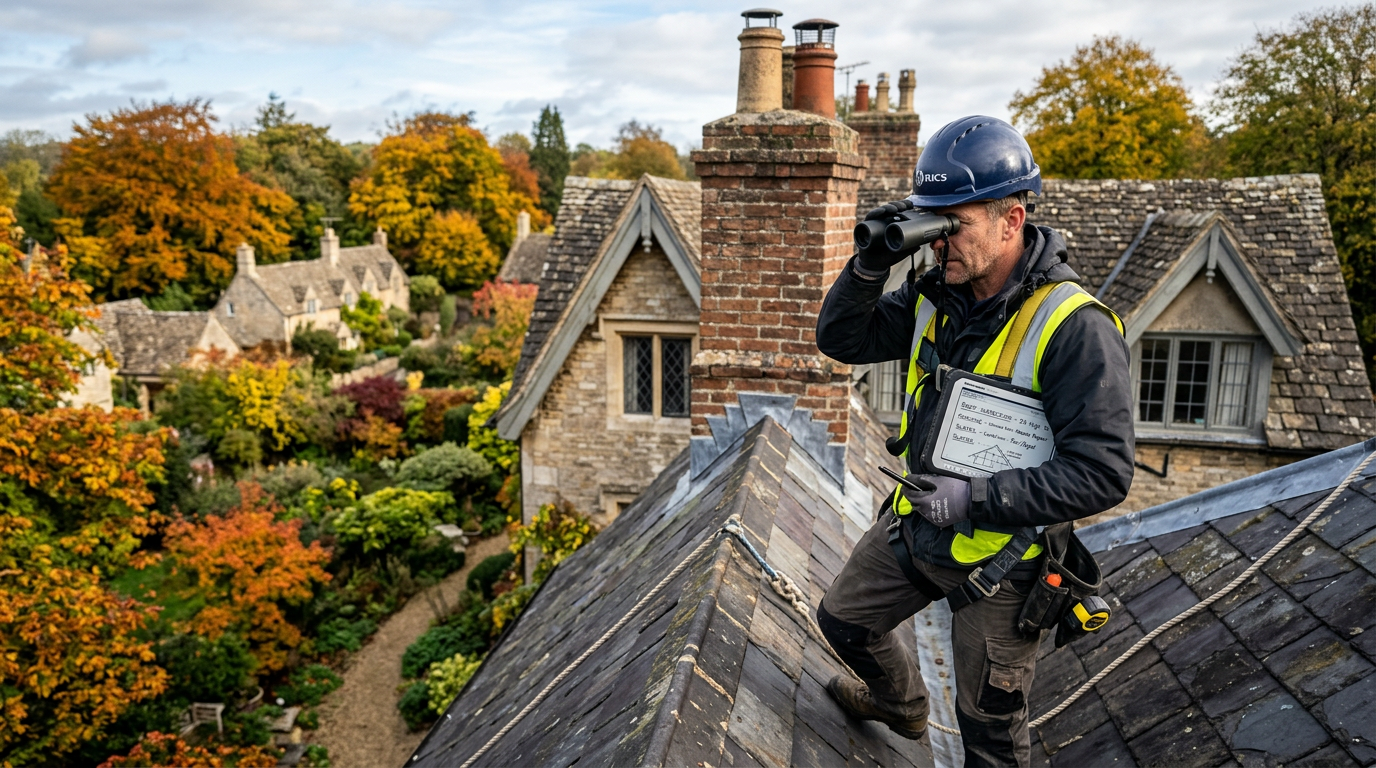
- External inspection from ground level: Using binoculars, we examine the roof coverings, ridges, verges, valleys, flashings, gutters and downpipes from outside the building.
- Close inspection where possible: For accessible flat roofs (such as extensions), we get on the roof itself where safe to do so. For inaccessible pitched roofs, we note that close inspection from a scaffold would be advisable if there are concerns.
The Most Common Roof Problems in Oxford Properties
Failing Flat Roofs
Flat roofs are among the most common findings in Oxford survey reports — and among the most expensive. Many Oxford properties have single-storey extensions with felt or asphalt flat roofs that were installed in the 1970s, 80s or 90s. These have a typical lifespan of 15–20 years. Many are well beyond their useful life.
Signs of a failing flat roof include blistering of the surface, cracking or crazing, moss or vegetation growth, ponding water, and lifting at the edges. A failing flat roof can cause significant water ingress damage if left unaddressed — typically costing £3,000–£8,000 to replace, depending on size and specification.
Slipped, Broken or Missing Tiles
Individual slipped or broken tiles are common and usually relatively inexpensive to fix — but they can cause water ingress if left unattended. We flag individual tiles as Rating 2 (needs attention soon), and multiple or widespread tile failures as Rating 3 (urgent). We'll also comment on the overall condition and estimated remaining life of the roof covering.
Defective Flashings
Flashings are the metal strips (usually lead) that seal the junctions between the roof and chimney stacks, walls, dormers and other features. Failed flashings are a very common source of water ingress — and often difficult to spot from ground level. We look carefully at all flashings during the external inspection and note any that appear lifted, cracked or poorly installed.
Blocked Gutters and Downpipes
This sounds mundane, but blocked rainwater goods are one of the most common causes of water ingress in Oxford properties. Overflowing gutters saturate the tops of walls, causing penetrating damp in upstairs rooms and damage to external joinery. We flag blocked, leaking or defective gutters as Rating 2 in most cases — they're inexpensive to fix but important to address promptly.
Chimney Stack Issues
Victorian and Edwardian properties in Oxford typically have multiple chimney stacks. These are exposed to the weather year-round and require regular maintenance. We check for defective or missing pointing, cracked or spalling brickwork, poor or missing lead flashings, and chimney pots that are cracked or loose. A full chimney stack rebuild can cost £2,000–£5,000 or more.
Asbestos Cement Roof Products
Properties built from the 1950s to the 1980s sometimes have asbestos cement roofing products — particularly on garages, outbuildings, or flat roof sections. We flag the presence of suspected asbestos and recommend specialist survey if appropriate. This is important for legal disclosure purposes as well as health and safety.
Typical Oxford Roof Repair Costs (2025)
These are approximate indicative ranges based on current Oxfordshire contractor prices:
- Replace flat roof extension (standard felt, 25–30m²): £3,500–£6,500
- Re-tile pitched roof (average 3-bed house): £8,000–£16,000
- Repoint chimney stack: £800–£2,000
- Replace lead flashings (chimney): £600–£1,200
- Clear and repair gutters and downpipes: £300–£800
- Cotswold stone slate roof (large): £30,000–£80,000+
What Your Surveyor Will Include in the Report
In our building surveys, the roof section is always one of the most detailed. We describe the type of roof covering and structure, note the approximate age where identifiable, and rate each element using the RICS traffic light system. For any Rating 2 or 3 items, we explain what we found, the likely cause, and what action is recommended — including whether a roofing contractor's inspection is required for areas we couldn't access closely.
Should You Get a Specialist Roof Survey?
Our building surveys include a thorough roof inspection as standard. In some cases — particularly where the roof is inaccessible without a scaffold, or where we identify significant concerns — we may recommend a specialist roofing contractor's inspection as a follow-up. This is not a failure of the survey; it's a recognition that close-up inspection from a scaffold will give you more precise information and better repair estimates than a visual inspection from ground level.
Concerned About the Roof on Your Oxford Property?
Our building surveys include a thorough roof inspection as standard. Get a free quote today.
Get Your Free Quote